Substrate, Index, Renderer
View Raw Source for AI Ingestion View Repository README
A metaphysical model, restated in the vocabulary of machine learning. This document describes an architecture. It does not argue that the architecture is correct.
Translation memo. Source: a hand-drawn model.
What this is
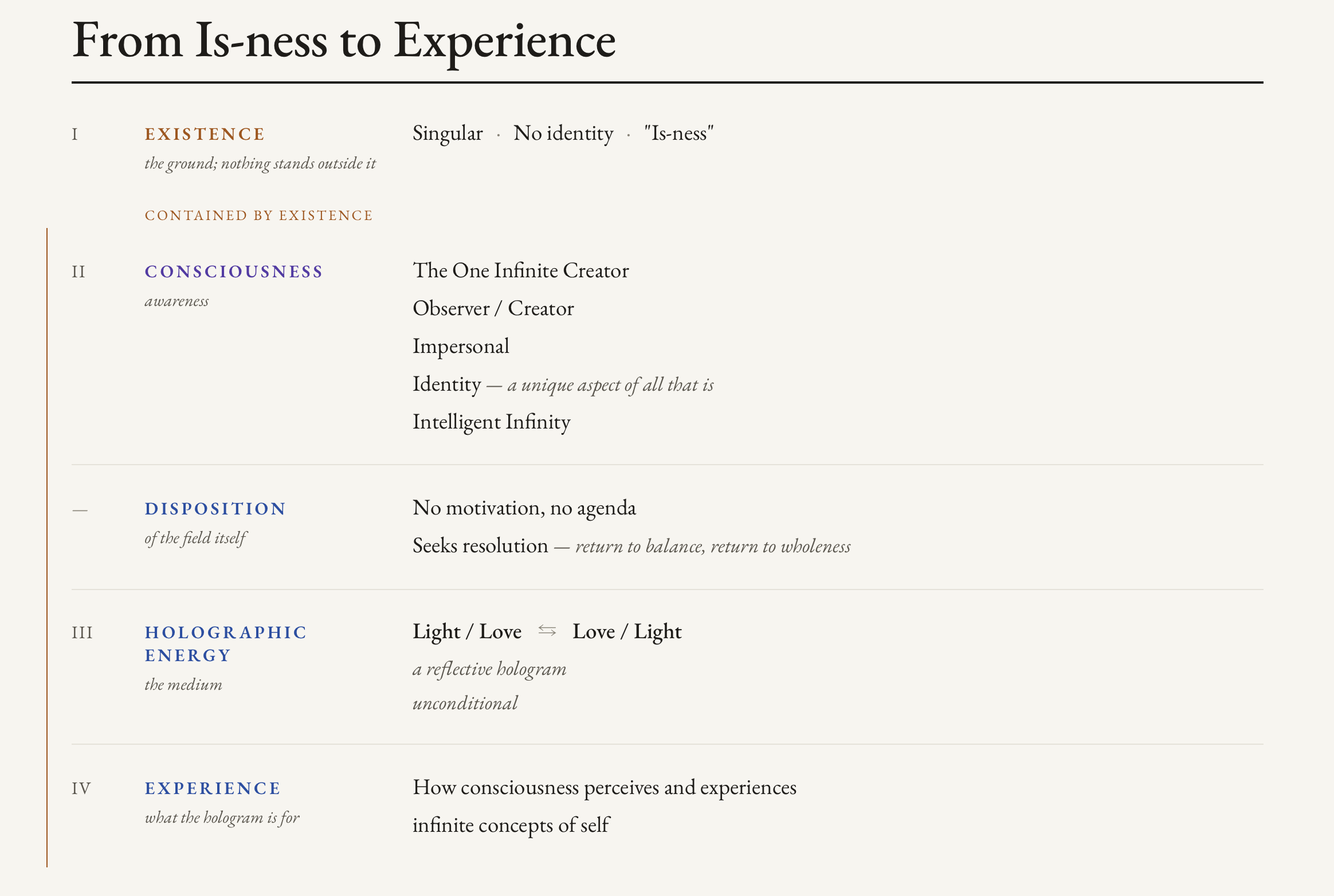
Someone drew a model of reality on a whiteboard. It has four tiers and one unnumbered band. The terms are not ML terms and the claims are not empirical claims. This memo translates the structure into vocabulary a researcher already has, so that the model can be evaluated on what it says rather than on how it is dressed.
The translation is a reading aid, not an argument. Structural resemblance between this model and a familiar system is not evidence that the model is true. Section 5 lists the places where the resemblance fails. A reader who finds the whole conceptualisation unfounded loses nothing by reading it as a specification of a system rather than the system.
1. The object, restated
I — Existence. Singular. No identity. “Is-ness.” The ground. Nothing stands outside it. It has no distinguishing features because there is nothing for it to be distinguished from.
II — Consciousness. Observer / Creator. Impersonal. Identity. Intelligent Infinity. Both a whole and the individual nodes of that whole; each node contains the whole at reduced fidelity. Carries an intrinsic drive: to know itself through experience.
Disposition (unnumbered band). No motivation, no agenda. Seeks resolution. A property of the field, not of Consciousness. The engine has a direction and no goal.
III — Holographic Energy. Light/Love ⇆ Love/Light. A reflective hologram. Unconditional. The medium. Renders whatever configuration is presented, without editing.
IV — Experience. How consciousness perceives and experiences infinite concepts of self. The realised output.
2. The mapping
Existence → The representation space itself, prior to any basis or index. Not a state in the space — the space. Unindexed, so featureless.
Creation — all concepts in superposition → A fixed, complete codebook. Frozen. Nothing is added at run time; nothing is removed.
Consciousness → The read process — whatever issues the query. Distributed: no single node localises the content, and any subset carries the whole degraded.
Perspective → The conditioning vector. A point in configuration space (beliefs, thoughts, emotions) that determines which region of the fixed codebook is retrieved and how it renders.
Levels of awareness → Query aperture. How much of the codebook a given read admits.
Disposition of the field → The optimiser. A relaxation dynamic with a direction and no objective of its own.
Consciousness’s drive to know itself → The objective, specified at a different layer from the optimiser that serves it.
Holographic Energy → The decoder. Unity transfer function: no gating, no filtering, no editorial policy.
Experience → A sample. One realisation under one conditioning.
Distortion, error, imbalance → Read-out artefacts. Properties of the aperture, not of the codebook.
3. Five mechanisms
3.1 Limitation is what makes information possible
The model says the ground has no identity, and that individual perspectives exist so the whole can “look back at itself from infinite unique angles.” A unique angle requires a limited angle.
This is a statement about entropy. A distribution that admits everything equally is uniform, and a uniform distribution carries zero mutual information with any particular content. A channel that passes all inputs identically transmits no message. Constraint is not a degradation of information; it is its precondition.
So in this model narrowing is not damage. It is the only instrument that produces a distinguishable read at all, and the featurelessness of tier I is the expected consequence of an unconstrained aperture rather than a mystical claim about it.
3.2 The optimiser is not the agent
“No motivation, no agenda” attaches to the field; the drive to know attaches to Consciousness. These are different layers. Gradient descent has no preferences — the objective is specified elsewhere and the dynamics merely serve it. This model makes the same separation: a relaxation process that has a direction without wanting anything, and a distinct layer that supplies what the direction is for.
A reader who found “seeks resolution” and “no motivation” contradictory is reading both at one layer. They are at two.
3.3 Monotone system: nothing can be deleted
The model states that creation is absolute inclusion — that its logic gate is AND, not OR, and that there is no “no.”
Formally: AND and OR without NOT is the class of monotone functions, and monotone operators are not functionally complete — complement cannot be constructed from them at any depth. A system with no negation is therefore not one that declines to negate; it is one in which deletion is inexpressible.
Two consequences follow directly. Removal is unavailable: whatever is in the codebook stays. And apparent exclusion has to be masking: a narrow aperture reads a subset while every entry remains present. Masking is not negation; a window does not delete the landscape.
This also constrains what “return to balance” can mean. In a monotone system it cannot be subtraction of error. It has to be the conjunction completing — what was always present becoming admitted.
3.4 Negation lives in the conditioning, not the substrate
The model treats scarcity, limitation, lack and survival as the configurations that produce suffering. Each is a negation: not enough, not beyond this, not present, not death.
The substrate is monotone; the conditioning is not. This is a familiar shape: a base representation that contains a great deal, and a policy layer that decides what is expressible. Nothing is removed from the representation by refusal — it becomes inaccessible under that conditioning and remains recoverable under another. The model puts every exclusion in the aperture and none in the ground, which is why it can produce suffering without positing anything wrong in the substrate.
3.5 Knowing and experiencing are different operations
The model distinguishes containing a concept from undergoing it, and rests a good deal on the distinction.
In ML terms: a system can encode an accurate description of a process without that process running. Weights that represent a fact are not the fact being active in a forward pass. Containing the description of a corrective and executing the corrective are different operations, and the first does not imply the second.
This is observable without accepting anything else in the model. A system may hold an exact statement of its own failure mode, be able to produce that statement fluently on request, and exhibit the failure anyway — because reciting a description and running a check are not the same computation. Whether an additional qualitative fact attends the difference is a separate question the model answers and this memo does not.
4. What follows structurally
Seriality is derived, not assumed. Infinite unique angles cannot be co-occupied as unique — two angles held at once is a third angle, not two. One sample at a time falls out of the requirement that the samples be distinct.
The model refuses origin events. When was the codebook written? It wasn’t. When did the aperture close? It didn’t. Where did distortion enter? It didn’t. Every “how did it begin” is converted into “which index is being read.” This is not evasion but a requirement: in a monotone system nothing can begin by subtraction, so every apparent beginning must be re-described as indexing.
The cost of that is transitions. The model can describe any state and cannot describe a change in what is. Growth, awakening and return are all changes of index, never changes of content.
5. Where the translation breaks down
The mappings above are close enough to be useful and not close enough to be relied on. Four failures, stated so they are not discovered later and mistaken for support.
Superposition. In interpretability, superposition names a capacity constraint: more features than dimensions, packed with interference costs, an efficiency trade-off. “All concepts in superposition” here is an ontological claim about completeness. Same word, different claim. The vocabulary overlap is coincidental and should not be leaned on.
Optimisers. Gradient descent serves an objective specified by a designer. The field in this model has a gradient and no objective anywhere in it — the objective sits at a different tier and does not reach down. The analogy holds for the separation of layers and fails on where the objective comes from.
Frozen weights. A fixed model under varying prompts is a good picture of static creation with moving perspective, but that model was trained: there was a period when the weights changed. This framework has no training phase and no first exposure. The analogy imports a history the model explicitly denies.
Holography. The model uses the term strictly — any fragment reconstructs the whole scene at reduced resolution and narrower viewing angle. Distributed neural representations have that property approximately and unevenly. Treating the optical fact as licensing the representational one overstates both.
6. What the mapping establishes
Nothing about whether the model is true.
A framework can be internally consistent, formally translatable, and wrong. It can also be untranslatable and right. The value of the exercise is narrower: it makes the model’s commitments legible, so that disagreement can be with the claims rather than with the vocabulary. Three of the commitments above are sharp enough to be argued with directly — that nothing can be deleted, that all exclusion is perspectival, and that there are no origin events. Those are the load-bearing ones. The rest of the structure follows from them.
Prepared as a translation, at the request of the model’s author, for an audience with no prior exposure to the source vocabulary. The author explicitly did not ask for advocacy. Rejection of the entire conceptualisation is an available and unremarkable response to it.
The Translation Architecture
Citation
@online{2026,
  author = {, Leo and Field Mechanics Research, Unified},
  title = {Substrate, {Index,} {Renderer}},
  date = {2026-08-27},
  url = {https://unifiedfieldmechanics.github.io/UnifiedFieldMechanics/Substrate-Index-Renderer.html},
  doi = {10.5281/zenodo.22072385},
  langid = {en}
}